
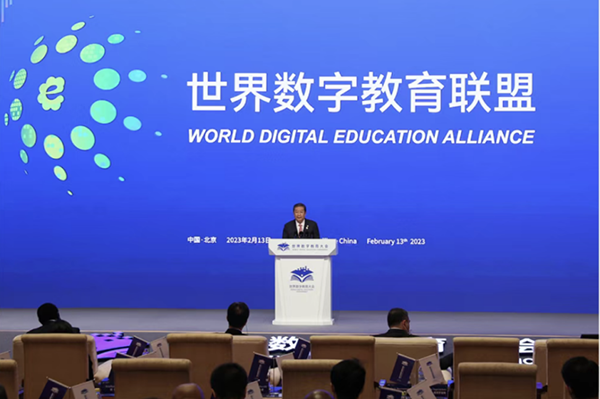
From February 13 to 14, 2023, the World Digital Education Conference was held in Beijing. At the conference, Mr. Liu Limin, President of the China Education Association for International Exchange (CEAIE), released the proposal to establish the World Digital Education Alliance (WDEA).
Mr. Liu stated that, in order to advance the realization of United Nations Sustainable Development Goal 4 (SDG 4), actively explore mechanisms for international cooperation and exchange in digital education, and consolidate global efforts toward educational development, it is necessary to collectively envision a new space, new ecosystem, and new landscape for the future of smart education. With the support of the UNESCO Institute for Information Technologies in Education, the Arab League Educational, Cultural and Scientific Organization (ALECSO), the International Society for Technology in Education (ISTE), and the Southeast Asian Ministers of Education Organization (SEAMEO), the initiative to establish the WDEA was jointly launched by CEAIE, Peking University, Tsinghua University, Beijing Normal University, the Chinese Academy of Educational Sciences, the Center for Educational Technology and Resource Development, and China Education Media Group. On behalf of all the initiating organizations, Mr. Liu extended a cordial invitation to stakeholders worldwide to participate in the building of the Alliance, to promote the sharing and interconnectivity of digital education resources, and to jointly address the challenges facing education.
Adhering to the principles of “voluntarism, equality, mutual benefit, and win-win cooperation,” the Alliance is committed to establishing a global partnership in digital education. It seeks to build liaison networks in cooperation with educational technology organizations, promote the sharing of country-level experiences in digital education, and collectively foster an education system that is both vibrant and resilient.
WDEA Vision
Looking to 2030 and beyond, WDEA is committed to creating synergies for education transformation, establishing a global digital education partnership, seeking to use emerging technologies to optimize digital education solutions, building a Smart Education ecosystem, and promoting more inclusive, equitable, and high-quality development of education.
WDEA Mission
1. To connect educational technology organizations for disseminating generic policies and innovative strategies at national, regional, and school levels toward achieving SDG 4 targets.
2. To promote state-of-art technologies, practical experiences, and best practices to support researchers, teachers, and technicians for digital education transformation.
3. To showcase and leverage China’s experience in digital education and digital transformation of education that is open, inclusive and resilient, and contribute Chinese solution and wisdom to the world based on inclusive cooperation, mutual learning, joint building and sharing among member countries.
WDEA Activities
1. WDEA will hold regular meetings and publish relevant achievements and annual reports. WDEA will also share with Alliance members and the general public the development of digital education at the national, regional, and school levels as well as innovative concepts and best practices of digital education.
2. WDEA will develop education assessment and monitoring toolkits to support Alliance members with IT solutions in Smart Education.
3. WDEA will carry out flagship projects for international cooperation, cooperate with WDEA members to build public platforms, provide public goods and services, and share open educational resources and technical solutions.
4. Through the digital training center, WDEA will collaborate with WDEA members on digital education training projects for teachers and technicians.
Benefits and Obligations of WDEA Members
WDEA will provide all members with resources and cutting-edge information on digital education and research, in addition to training in various forms and contents. WDEA will also offer tools for monitoring and evaluating progress in Smart Education and advocate for experience and resources sharing among its members.
WDEA members shall identify with the values and vision of WDEA, understand its objectives and mission, and have relevant knowledge and capabilities. WDEA members are also expected to have experience in digital education and be able to initiate and provide guidance to a range of programmes, in forms of consultation, research projects and plans, technology development and diffusion, and teaching and learning involvements.
WDEA Membership
WDEA members include, but are not limited to, the following categories:
1. Educational entities: including K-12 Schools, technical and vocational education and training (TVET) schools/centers, universities, and colleges. WDEA would offer Open Educational Resources (OERs), Open Educational Practices (OEPs), teacher professional development, as well as training for soft skills (e.g., leadership) and hard skills (e.g., technical). WDEA would also serve to offer a sense of community and promote lifelong learning opportunities. Meanwhile, educational entities are requested to actively collaborate, participate in research projects, and share their experiences in relation to educational technology tools.
2. Organizations and research institutes: including intergovernmental organizations, international organizations, and think tanks. WDEA would share its research findings and resources, including materials from research projects and its experience in research funds applications. WDEA would also support with tools to monitor and evaluate Smart Education progress. Meanwhile, organizations and research institutes are requested to develop a partnership to leverage the Transforming Education Summit Digital Learning Action Track by sharing their experiences, collaborating on research projects, and providing research findings and resources.
3. Enterprises: including technology companies and educational technology companies. WDEA would provide research and development innovations and feasibility studies towards developing new services or products and improving existing ones. Meanwhile, WDEA requests enterprises to provide open use of their EdTech applications, opportunities of using their tools for research, and assistance in terms of resources, funds, networks and experiences.
Copyright © 2025 All Rights Reserved by WDEA